What Is Melasma? Causes, Types and How to Treat It Effectively
Melasma is one of the most common — and most challenging — pigmentation disorders encountered in aesthetic dermatology. Characterised by symmetrical patches of brown or grey-brown discolouration, it affects an estimated 5–6 million people in the United States alone, with prevalence significantly higher in Middle Eastern, South Asian, and Latin populations. Yet despite its frequency, melasma remains widely misunderstood, undertreated, and prone to relapse. This article explains what melasma is, what triggers it, how to classify its type, and what injectable brightening treatments have shown the most consistent clinical results.
What Is Melasma?
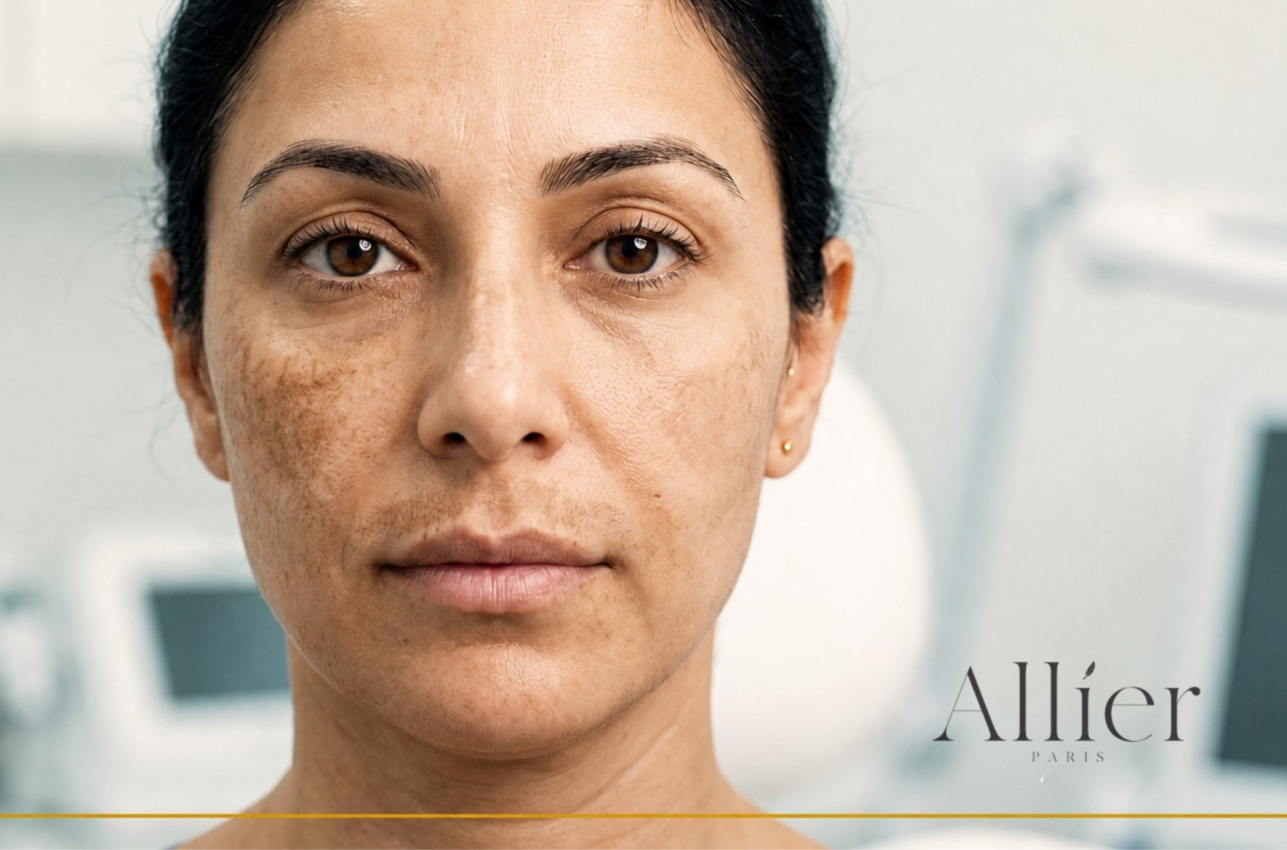
Melasma is a chronic, acquired disorder of cutaneous hyperpigmentation. It manifests as irregular, sharply demarcated macules and patches of brown or greyish discolouration, most commonly distributed symmetrically across the face — particularly the cheeks, upper lip, forehead, nose, and chin. In some cases it can also affect the neck, forearms, and chest, though facial presentation predominates.
At the cellular level, melasma is driven by the overactivation of melanocytes — the pigment-producing cells of the basal layer of the epidermis. Stimulated melanocytes produce excess melanin, which accumulates in the epidermis (and sometimes the dermis), creating the characteristic dark patches. The condition is not associated with any systemic disease, but its visible nature means it carries significant psychological and quality-of-life impact for patients.
CLINICAL NOTE: Melasma is not the same as a sunspot or post-inflammatory hyperpigmentation (PIH). Clinically distinguishing between these three presentations is essential before selecting a treatment protocol, as each has a different underlying mechanism and responds differently to treatment.
What Causes Melasma?
Melasma is multifactorial — no single trigger causes it, and multiple factors typically interact. The most established causative factors are:
UV and Visible Light Exposure
Ultraviolet radiation is the primary environmental trigger. UV-A and UV-B rays stimulate melanocyte activity directly and upregulate the key enzyme tyrosinase, which catalyses the rate-limiting step in melanin synthesis. Notably, visible light (particularly high-energy visible, or HEV, light from screens and sunlight) has also been shown to induce melasma, which is clinically relevant because standard chemical sunscreens do not block HEV light — only tinted physical (mineral) sunscreens with iron oxides do.
Hormonal Influence
Oestrogen and progesterone have a direct stimulatory effect on melanocytes. This explains why melasma is far more prevalent in women than men (approximately 9:1 ratio) and commonly appears or worsens during pregnancy (chloasma, or the mask of pregnancy), with oral contraceptive use, or during hormone replacement therapy. In some women, melasma persists long after hormonal triggers are removed, suggesting a chronic sensitisation of the melanocytes.
Genetic Predisposition
A positive family history is found in 40-50% of patients with melasma. Individuals of Fitzpatrick skin types III-V are significantly more susceptible, explaining the higher prevalence in Middle Eastern, South Asian, East Asian, and Latin populations.
Heat and Infrared Radiation
Emerging evidence suggests that thermal (heat) energy can also stimulate melanocyte activity, independent of UV exposure. This has important practical implications — patients should be counselled to avoid heat-generating activities (saunas, hot yoga, cooking over direct heat) during active melasma treatment.
Thyroid Dysfunction
Some studies have identified an association between thyroid disease (particularly hypothyroidism) and melasma, suggesting a systemic hormonal component beyond sex hormones. Practitioners should consider thyroid screening in patients with treatment-resistant melasma.
Who Is Most at Risk?
Melasma predominantly affects women (over 90% of cases) aged 20-50, though it can occur in men. Risk is highest in:
- Individuals with Fitzpatrick skin types III-V (olive to dark skin tones)
- Women who are pregnant, taking oral contraceptives, or undergoing HRT
- People with a family history of melasma
- Those living in high-UV environments or with occupational sun exposure
- Patients with thyroid disorders
- Individuals of Middle Eastern, South Asian, East Asian, or Latin ancestry
In the MENA region specifically, melasma is one of the top three presenting pigmentation concerns in dermatology and aesthetic clinics, driven by high UV index, genetic predisposition, and widespread use of hormonal contraception.
How Is Melasma Diagnosed?
Melasma is typically diagnosed clinically by visual examination, supplemented by Wood’s lamp assessment to classify pigment depth. A thorough patient history should capture:
- Duration and progression of pigmentation
- Hormonal history (contraception, pregnancy, HRT)
- Sun exposure habits and current photoprotection
- Previous treatments and response
- Family history and skin phototype (Fitzpatrick classification)
- Any associated thyroid symptoms
Dermoscopy can provide additional information, revealing pseudonetwork patterns and vascular structures. Skin biopsy is not routinely needed unless an alternative diagnosis (such as Hori’s naevus or exogenous ochronosis) is suspected.
Treatment Options: Topical, Procedural, and Injectable
Melasma treatment requires a multi-modal approach. No single treatment achieves complete or permanent clearance. The established hierarchy of options is:
Option 1: Strict Photoprotection (Non-Negotiable)
Broad-spectrum SPF 50+ sunscreen with UVA + UVB + HEV (visible light) protection is the foundation of every melasma protocol. Without it, all other treatments will fail. Tinted mineral sunscreens containing iron oxides are specifically required to block visible light.
Option 2: Topical Depigmenting Agents
Hydroquinone (2-4%) remains the gold standard, though concerns about long-term use and ochronosis risk exist. Combination formulas (e.g., the Kligman-Willis triple combination of hydroquinone + tretinoin + topical steroid) offer enhanced efficacy. Non-hydroquinone alternatives with strong evidence include kojic acid, tranexamic acid, niacinamide, azelaic acid, and arbutin.
Option 3: Procedural Treatments
Chemical peels (glycolic, mandelic, trichloroacetic acid), microneedling, and laser treatments (low-fluence Q-switched Nd:YAG, pico lasers) can accelerate improvement but carry a risk of post-inflammatory hyperpigmentation — particularly in darker skin types. They should be used with caution and combined with rigorous pre- and post-treatment depigmentation protocols.
Option 4: Injectable Brightening Protocols
Injectable mesotherapy solutions targeting melanogenesis at the dermal level represent one of the most significant recent advances in melasma management. Unlike topical agents, which are limited by epidermal penetration, injectable protocols deliver active brightening ingredients directly to the site of melanocyte activity, achieving results that topical treatments cannot reach alone.
CLINICAL INSIGHT: For dermal and mixed melasma specifically, injectable protocols offer a clinical advantage that topical-only approaches cannot match — direct delivery of tyrosinase inhibitors and anti-pigment actives to the dermis where excess melanin deposition occurs.
MELASMA BRIGHT by Allier Paris: Mechanism and Clinical Application
MELASMA BRIGHT is a professional-grade injectable solution developed by Allier Paris specifically to address melasma and diffuse hyperpigmentation. Its formulation targets pigmentation at three key stages of the melanin production pathway:
- Tyrosinase inhibition — blocking the rate-limiting enzymatic step in melanin synthesis
- Melanocyte activity modulation — reducing the hyperstimulation of melanocytes by UV and hormonal triggers
- Pigment spot reduction — acting on existing accumulated melanin deposits to progressively lighten established patches
- New pigment prevention — disrupting the signalling cascade that promotes new melanin formation following UV exposure
The product tagline — ‘Brightening Pigmentation, Brighter Skin, Lighter Spot. Stop New Pigments’ — reflects this dual action: correcting existing discolouration while preventing new formation.
 Recommended Clinical Use
- Indicated for: epidermal, mixed, and moderate dermal melasma
- Skin types: Fitzpatrick III-VI (specifically formulated for darker skin tones where laser risk is elevated)
- Protocol: discussed with your Allier Paris distributor or regional representative
- Combine with: SPF 50+ daily sun protection, topical maintenance, Allier GENOWHITE or INSTANT GLOW for synergistic results
- Available through: authorised aesthetic clinics and distributor network — for professional use only
PROFESSIONAL USE ONLY: MELASMA BRIGHT is available exclusively for use by qualified aesthetic practitioners and dermatologists. Contact your Allier Paris regional representative for treatment protocols and access.
How to Prevent Melasma from Returning
Melasma is a chronic condition with a high recurrence rate — even after successful treatment, melasma commonly returns with sun exposure or hormonal fluctuation. Long-term management must address prevention, not just correction:
- Daily broad-spectrum SPF 50+ with visible light protection — applied every morning, reapplied every 2 hours during outdoor activity
- Lifestyle modifications: avoiding peak UV hours (10am-4pm), wearing protective clothing and wide-brimmed hats
- Hormonal review: consider alternative contraception if melasma is hormonally driven and refractory to treatment
- Maintenance topical: low-dose depigmenting agent (kojic acid, azelaic acid, or niacinamide) applied 2-3 nights per week
- Annual reassessment: skin phototype reassessment, pigment depth re-evaluation, and protocol adjustment as needed
- Heat avoidance: limit saunas, prolonged heat exposure, and direct cooking heat during active treatment phases
Frequently Asked Questions
Q: Is melasma permanent?
Melasma is a chronic condition, but it is not permanent in the sense that it cannot be improved. With the right combination of photoprotection, depigmenting treatments, and injectable protocols, significant lightening is achievable for most patients. However, complete permanent removal is rarely possible, and ongoing maintenance is required to prevent recurrence.
Q: Can men get melasma?
Yes, though melasma is far less common in men, accounting for approximately 10% of cases. The clinical presentation and treatment approach are the same, but male patients often have stronger UV exposure through occupational or lifestyle habits, which should be addressed in the management plan.
Q: How long does melasma treatment take to show results?
With topical depigmenting agents, visible improvement typically begins at 6-8 weeks, with significant improvement by 3-6 months of consistent use. Injectable brightening protocols such as MELASMA BRIGHT can accelerate visible improvement, with many patients noticing clearer skin within 2-4 weeks of beginning a professional protocol. Results vary based on melasma depth, skin type, and patient compliance with sun protection.
Q: Is it safe to treat melasma on dark skin tones?
Yes, but careful product selection is critical. Dark skin tones (Fitzpatrick IV-VI) carry a higher risk of post-inflammatory hyperpigmentation from aggressive treatments such as high-dose peels or laser. Injectable mesotherapy protocols are generally well-tolerated across all skin tones and represent a safer primary approach for darker skin types. Your practitioner should assess your Fitzpatrick phototype before initiating treatment.
Q: Can melasma come back after treatment?
Yes — relapse is common, particularly with sun exposure or hormonal changes. This is why maintenance sun protection and a preventive topical regimen are essential components of any melasma management protocol. Periodic maintenance injectable sessions may also be recommended by your practitioner.